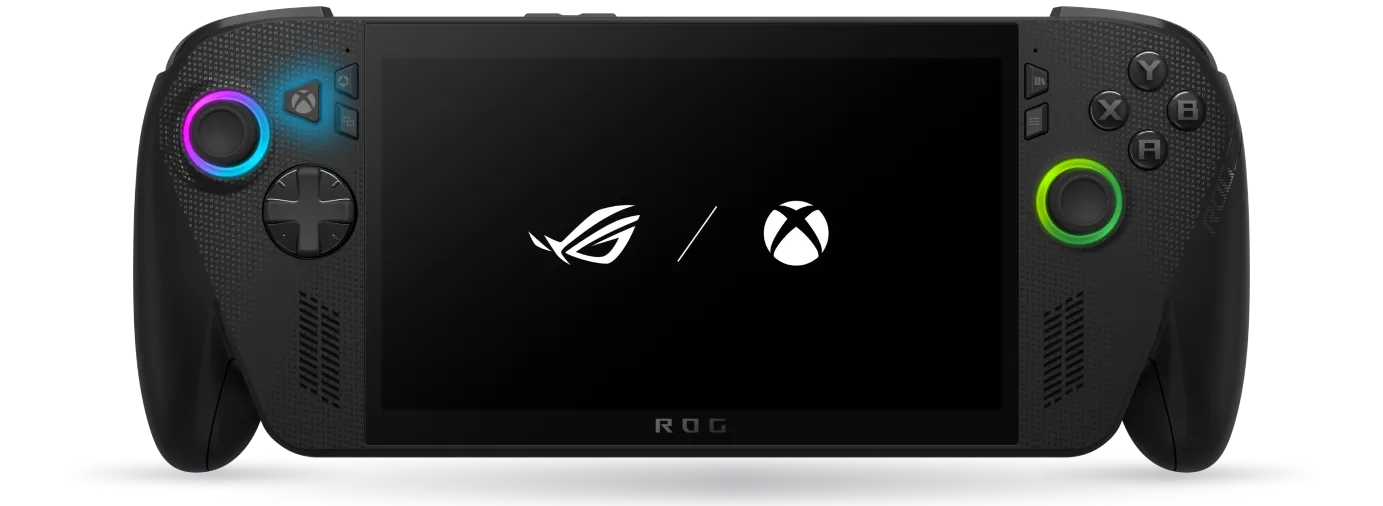
Premium Xbox-focused handheld hardware with a console-like layer on top of Windows.
Presets
5
Benchmarks
11
Best FPS
83
Avg FPS
52

Operating system
Windows 11 with Xbox Full Screen Experience
Processor
AMD Ryzen AI Z2 Extreme
Memory
24 GB LPDDR5X
Display
7 inch
Battery
80 Wh
Weight
715 g
Hardware
Operating system
Windows 11 with Xbox Full Screen Experience
Processor
AMD Ryzen AI Z2 Extreme
Memory
24 GB LPDDR5X
Storage
1 TB NVMe SSD
Display size
7 inch
Resolution
1920 × 1080
Refresh rate
120 Hz VRR
Battery
80 Wh
Weight
715 g
Atlas data
Highest tested
83 FPS
Average tested
52 FPS
Published presets
5
Published benchmarks
11
Device profile
Performance data and presets shown below are loaded directly from the live HandheldAtlas database.
Game settings
Batman: Arkham Knight was tested on the ROG Xbox Ally X at native 1920 × 1080 using a 35W profile with no upscaling. Across three CapFrameX gameplay runs, the profile averaged 49 FPS, with a 34 FPS 1% low and an approximately 25 FPS 0.1% low. This is a native-resolution visual-quality profile that generally stays above a 40 FPS target. The exact route, capture duration, game build and driver version were not retained and therefore remain unreported.
Confidence 71/100 · 0 confirmed
Resolution
1920 x 1080
TDP
35W
Average
49 FPS
1% Low
34 FPS
Why: Fullscreen keeps the benchmark presentation path consistent and avoids an unnecessary desktop-composition layer.
Why: Native 1920 × 1080 preserves clarity on the Ally X display; lowering it is the first option if more headroom is needed.
Why: Disabled for the measurement so synchronization does not cap or reshape the captured frame-rate result.
Why: A 90 FPS ceiling prevents runaway menu load while staying well above this profile's measured target.
Why: Normal limits memory pressure while retaining clear textures at 1080p.
Why: Normal avoids the heavier cost of high-resolution shadows while keeping scene depth intact.
Why: Normal balances object detail and traversal performance in the tested 1080p profile.
Balanced 40 FPS preset for Assassin’s Creed Origins on the ROG Xbox Ally X. Tested at 1920x1080 with a 35W performance profile. Across three CapFrameX runs, the game averaged around 42 FPS with a 1% Low of approximately 32 FPS. This preset is aimed at smooth and stable open-world gameplay rather than high refresh-rate performance. Frame pacing is generally solid for a 40 FPS target, although heavier city areas, fast traversal or dense scenes may still cause occasional short drops.
Confidence 74/100 · 0 confirmed
Resolution
1920 x 1080
TDP
35W
Average
42 FPS
1% Low
32 FPS
Arena Breakout: Infinite was tested on the ROG Xbox Ally X at 1920 × 1080 using a 35W profile. The custom configuration uses FSR Performance with FSR Frame Generation, Windowed Full-Screen, V-Sync Off, a 240 FPS ceiling and no main-screen frame-rate limit. Variable Rate Rendering was disabled. Across three CapFrameX gameplay runs, the frame-generated output averaged approximately 80 FPS with a 31 FPS 1% low. The gap between the average and 1% low indicates occasional heavier transitions or frame-time spikes. The exact route, capture duration, game build and driver version were not retained.
Confidence 76/100 · 0 confirmed
Resolution
1920 x 1080
TDP
35W
Average
80 FPS
1% Low
31 FPS
Devil May Cry 5 was tested on the ROG Xbox Ally X at native 1920 × 1080 using a 35W docked profile and 100% resolution scaling. The measured custom profile uses Ultra textures, texture filtering and mesh quality; High effects and volumetric lighting; Low shadows; FXAA + TAA; and disables motion blur, ambient occlusion, bloom and chromatic aberration. A stable CapFrameX gameplay segment averaged 46.6 FPS, with a 34.8 FPS 1% low and a 33.9 FPS 0.1% low. GPU usage was approximately 96%, so this should be treated as a GPU-limited visual-quality profile rather than a 60 FPS target.
Confidence 83/100 · 1 confirmed
Resolution
1920 x 1080
TDP
35W
Average
47 FPS
1% Low
35 FPS
Cyberpunk 2077 was tested on the ROG Xbox Ally X at 1920 × 1080 with a 35W profile, 10GB VRAM allocation, FSR 2.1 Auto reconstruction and FSR 3.1 Frame Generation. The recorded configuration also had Radeon Super Resolution and AMD Fluid Motion Frames enabled at driver level. The stored result reports an 83 FPS average and a 65 FPS 1% low. These are output-frame figures from a frame-generated configuration. The original capture tool, run count, test route, game build and driver version were not retained, so treat this as a historical Atlas result and retest it after major game or driver updates.
Confidence 73/100 · 1 confirmed
Resolution
1920x1080
TDP
35W
Average
83 FPS
1% Low
65 FPS
Performance data
| Game | Preset | Resolution | TDP | Average | 1% Low | Battery |
|---|---|---|---|---|---|---|
| Cyberpunk 2077 | Docked · Crisp 1080p Quality with Headroom | 1920 x 1080 | 35W | 83 FPS | 65 FPS | Not set |
| Unknown game | Performance · Docked / 80 FPS Target | 1920 x 1080 | 35W | 80 FPS | 31 FPS | N/A / Docked |
| Cyberpunk 2077 | Custom | 1280 × 720 | 35W (charger connected) | 64 FPS | — | Not set |
| Cyberpunk 2077 | Custom | 1280 × 720 | 25W | 61 FPS | — | Not set |
| Batman: Arkham Knight | Docked · Native 1080p 50FPS | 1920 x 1080 | 35W | 49 FPS | 34 FPS | N/A / Docked |
| Devil May Cry 5 | Docked · Visual Quality / High–Ultra Native 1080p | 1920 x 1080 | 35W | 47 FPS | 35 FPS | N/A |
| Cyberpunk 2077 | Custom | 1280 × 720 | 17W | 43 FPS | — | Not set |
| Assassin's Creed Origins | Balanced · Balanced 40 FPS | 1920 x 1080 | 35W | 42 FPS | 32 FPS | N/A / Docked |
| Cyberpunk 2077 | Custom | 1920 × 1080 | 35W (charger connected) | 40 FPS | — | Not set |
| Cyberpunk 2077 | Custom | 1920 × 1080 | 25W | 37 FPS | — | Not set |
| Cyberpunk 2077 | Custom | 1920 × 1080 | 17W | 28 FPS | — | Not set |
Why: Disabled for clearer motion and easier visual inspection of frame pacing.
Why: Enabled to control edge shimmer at native 1080p.
Why: Disabled to preserve image clarity; it is a stylistic effect rather than useful detail.
Why: Disabled to keep the small display and captured footage cleaner.
Why: 16× anisotropic filtering improves angled texture clarity with little cost on this target.
Why: Disabled to avoid extra effects load during rain-heavy scenes.
Why: Disabled to reserve GPU headroom for the native 1080p target.
Why: Set to the tester's neutral visibility preference; it does not materially change GPU performance.
Why: Native 16:9 matches the 1920 × 1080 test output without stretching.
Why: Native 1920 × 1080 defines the measured target and preserves panel clarity.
Why: 100% keeps the internal render resolution fixed at the stated 1080p target.
Why: 180 Hz leaves the display uncapped while CapFrameX measures the game's actual output.
Why: Disabled so synchronization does not cap or reshape the benchmark result.
Why: Disabled during capture so the measured average and lows reflect the profile rather than a limiter.
Why: Disabled to keep the capture path and SDR comparison consistent.
Why: Disabled so resolution remains reproducible throughout all three runs.
Why: High improves edge stability at native resolution while retaining the 40 FPS target.
Why: Medium reduces one of the heavier GPU costs without removing useful scene depth.
Why: Medium controls open-world detail cost in dense areas and traversal.
Why: High preserves texture clarity; the Ally X memory budget can support it at this target.
Why: High retains surface geometry detail while the profile reduces cost elsewhere.
Why: High keeps landscape detail clear in the open-world test target.
Why: 16:9 matches the 1920 × 1080 output used for all three captures.
Why: Native 1080p is the fixed output target for this docked profile.
Why: Windowed Full-screen keeps overlays and capture switching reliable during testing.
Why: Custom is required because the measured profile mixes quality levels instead of using a stock preset.
Why: 240 keeps the game effectively uncapped for measurement while preventing runaway menu output.
Why: Disabled so synchronization does not cap the CapFrameX capture.
Why: Disabled so the benchmark records the profile's actual output.
Why: Disabled to keep image quality behavior consistent across the three runs.
Why: AMD FSR is the selected reconstruction path for the 1080p performance target.
Why: Performance mode supplies the GPU headroom needed for the high-output target.
Why: FSR Frame Generation is enabled; the reported output FPS therefore includes generated frames.
Why: Basic reduces distant-scene CPU and GPU load during traversal.
Why: Basic reduces a costly effect to protect frame-time lows.
Why: Basic is the tested internal quality control within this custom profile.
Why: Quality retains clarity and effects where the profile has remaining headroom.
Why: Balanced limits memory pressure while preserving readable surfaces at 1080p.
Why: Basic reduces combat-effects load during heavier scenes.
Why: Basic lowers foliage density and protects performance outdoors.
Default: 1920x1080 | Problem: image clarity | Why: Native 1080p keeps the image sharp on a 1080p display | FPS: -4 | Visual: High | Restart: No
Default: Borderless Window | Problem: alt-tab stability / capture compatibility | Why: Borderless improves convenience and works well with overlays and recording tools | FPS: 0 | Visual: Low | Restart: No
Default: Variable | Problem: FPS limit | Why: Variable allows the game to use all available performance instead of forcing a fixed cap | FPS: +2 | Visual: Low | Restart: No
Default: 180.00Hz | Problem: display smoothness / input latency | Why: 180Hz allows lower latency and smoother frame delivery even with variable FPS | FPS: 0 | Visual: Low | Restart: No
Default: Off | Problem: input latency | Why: Off reduces input lag and avoids performance stalls, especially on handheld hardware | FPS: +1 | Visual: Low | Restart: No
Default: Normal | Problem: rendering compatibility | Why: Normal keeps the game stable and avoids unnecessary experimental rendering behavior | FPS: 0 | Visual: Low | Restart: No
Default: 100% | Problem: blurry image / upscaling artifacts | Why: 100% keeps native internal resolution with no upscaling or image softness | FPS: -4 | Visual: High | Restart: No
Default: Ultra | Problem: low texture detail | Why: Ultra keeps character, weapon and environment textures sharp | FPS: -2 | Visual: High | Restart: No
Default: Ultra | Problem: blurry textures at angles | Why: Ultra keeps surfaces sharper with almost no major FPS cost | FPS: -1 | Visual: Medium | Restart: No
Default: Ultra | Problem: object detail / geometry quality | Why: Ultra keeps models and environment detail cleaner | FPS: -2 | Visual: High | Restart: No
Default: FXAA+TAA | Problem: jagged edges / shimmering | Why: FXAA+TAA smooths edges and improves image stability | FPS: -2 | Visual: High | Restart: No
Default: On | Problem: blurred motion / reduced clarity | Why: Off keeps the image sharper during fast combat | FPS: +1 | Visual: Medium | Restart: No
Default: High | Problem: combat effects quality | Why: High keeps attacks, particles and visual effects looking strong without going full GPU murder mode | FPS: -3 | Visual: High | Restart: No
Default: Medium | Problem: heavy GPU load | Why: Low saves GPU time while retaining usable shadow definition on the handheld | FPS: +4 | Visual: Medium | Restart: No
Default: Off | Problem: VRAM / memory usage | Why: Off avoids extra memory pressure on handheld hardware | FPS: 0 | Visual: Low | Restart: No
Default: Off | Problem: GPU load / darkening cost | Why: Off improves performance and avoids extra shadowing cost | FPS: +3 | Visual: Medium | Restart: No
Default: Off | Problem: glow / overbright highlights | Why: Off keeps the image cleaner and slightly sharper | FPS: +1 | Visual: Low | Restart: No
Default: On | Problem: cinematic light glare | Why: On keeps the intended flashy DMC look with minimal performance cost | FPS: 0 | Visual: Low | Restart: No
Default: High | Problem: lighting atmosphere quality | Why: High keeps fog and volumetric lighting looking richer | FPS: -3 | Visual: High | Restart: No Screen Space Reflections
Default: Variable | Problem: reflection quality / GPU load | Why: Variable balances reflection quality depending on scene demand | FPS: 0 | Visual: Medium | Restart: No
Default: Variable | Problem: skin/material light softness | Why: Variable keeps character materials more natural without forcing max cost | FPS: 0 | Visual: Medium | Restart: No
Default: Off | Problem: color fringing / image clarity | Why: Off removes fake lens distortion and keeps the image cleaner | FPS: 0 | Visual: Low | Restart: No
Default: SRGB | Problem: color accuracy | Why: SRGB provides standard, consistent colors for SDR displays | FPS: 0 | Visual: Medium | Restart: No
Why: The measured profile used a 10GB UMA allocation to support 1080p textures and the game's memory demand.
Why: Disabled so synchronization does not cap the measured output.
Why: 144 keeps the game effectively uncapped relative to this profile's measured range.
Why: 1920 × 1080 is the exact output target used for the recorded result.
Why: Custom is required because the profile mixes its own scaling, effects and quality values.
Why: AMD FidelityFX Super Resolution 2.1 is the in-game reconstruction path recorded for this test.
Why: Auto allows the game to select its FSR 2.1 render ratio for the 1080p output target.
Why: 0.50 restores some edge clarity after FSR reconstruction.
Why: FSR 3.1 Frame Generation is enabled; reported output FPS therefore includes generated frames.
Why: Disabled to avoid the large GPU cost on the handheld.
Why: Low reduces CPU and GPU load in dense Night City scenes.
Why: Medium reduces small-object density to protect lows in busy scenes.
Why: Medium limits volumetric cost while retaining atmosphere.
Why: Medium balances reflections and simulation detail against GPU load.
Why: Medium preserves visible reflections without the full high-quality cost.
Why: Enabled because the tested profile retained the game's cloud presentation.
Why: High preserves texture clarity; the Ally X memory budget can support it at this target.
Why: High protects character detail in dialogue and close combat.
Why: Disabled to recover GPU headroom for the native-resolution 40 FPS target.
Why: Disabled for a clearer image and to avoid an optional post-processing pass.
Why: Basic reduces shader complexity for the performance-focused target.
Why: Basic lowers dynamic-lighting cost and helps frame-time consistency.
Why: Basic controls environmental complexity during traversal.
Why: Performance reduces the extra rendering cost when aiming through scopes.
Why: Personal field-of-view preference; use the same value when comparing results because a wider view can change scene load.
Why: Disabled for a cleaner image on the handheld display.
Why: Disabled to avoid color fringing and preserve clarity.
Why: Disabled for a consistently sharp gameplay image.
Why: Low controls one of the game's heavier effects to protect frame-time headroom.
Why: Disabled to reserve GPU time for the 1080p output target.